
Etiquette Throwback 1922: Taking Leave
In our final installment of our series on Formal Dinners from Emily's 1922 edition of Etiquette, Emily re-addresses taking leave at the end of the party.

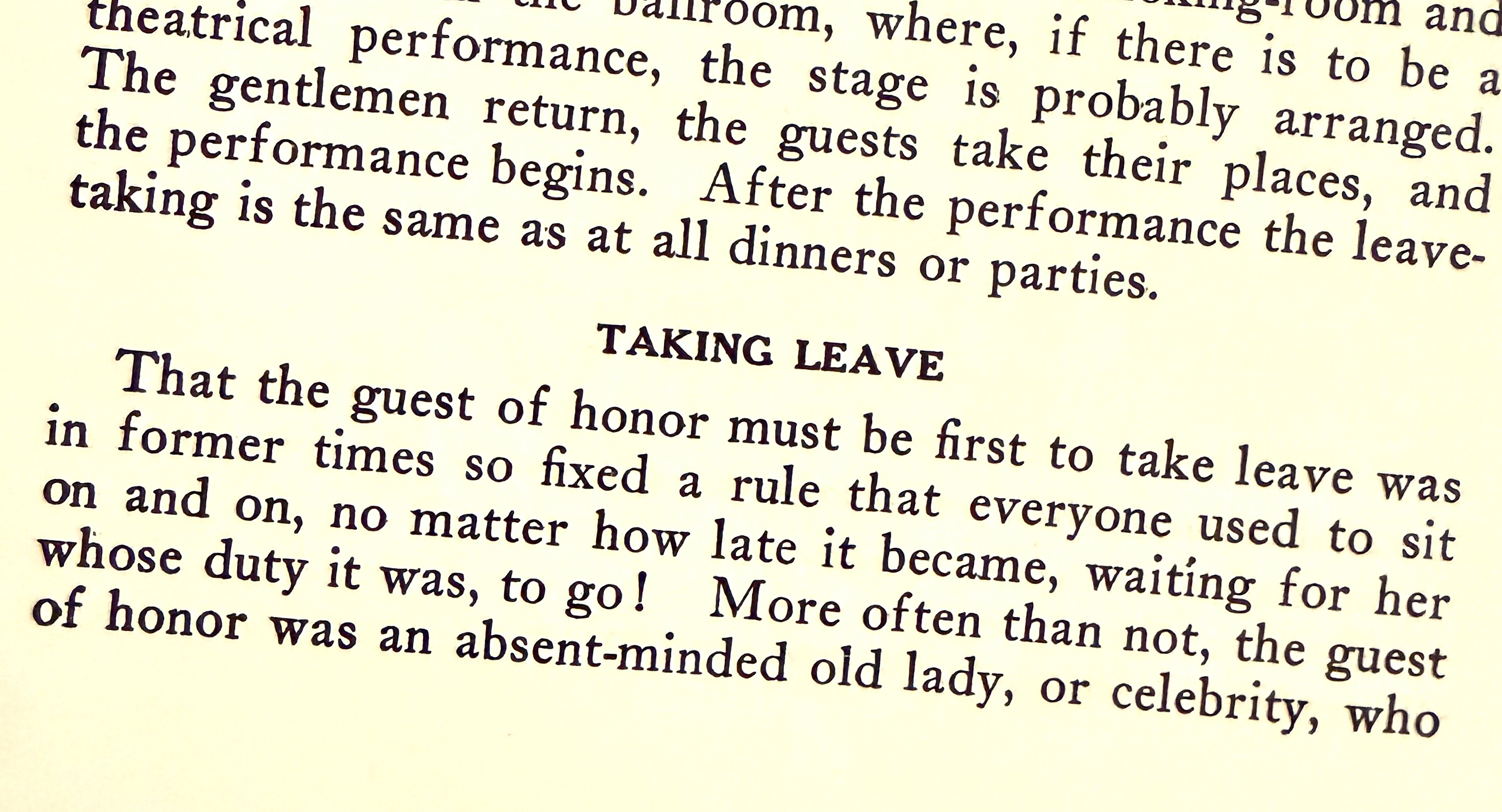
Etiquette, 1922, Taking Leave
As we wind down our series on Formal Dinners from Emily’s 1922 edition of Etiquette, Emily readdresses the question of how guests should take their leave at the end of the party. Emily begins the section by describing former traditions surrounding taking leave, highlighting their flaws. Practicality being one of her best traits, she continues on, letting the reader know what to do when traditions and rules fail.
*Please note that the grammar, spelling, and attitude in the following excerpt follow early 20th-century standards, and we have included the excerpt as is, with any typos that were printed in the book at the time.
FORMAL DINNERS
Taking Leave
pg 226-228
TAKING LEAVE
That the guest of honor must be first to take leave was in former times so fixed a rule that everyone used to sit on and on, no matter how late it became, waiting for her whose duty it was, to go! More often than not, the guest of honor was an absent-minded old lady, or celebrity, who very likely was vaguely saying to herself, “Oh, my! are these people never going home?” until by and by it dawned upon her that the obligation was her own!
But to-day, although it is still the obligation of the guest who sat on the host’s right to make the move to go, it is not considered ill-mannered, if the hour is growing late, for another lady to rise first. In fact, unless the guest of honor is one really, meaning a stranger or an elderly lady of distinction, there is no actual precedence in being the one first to go. If the hour is very early when the first lady rises, the hostess, who always rises too, very likely says: “I hope you are not thinking of going!”
The guest answers, “We don’t want to in the least, but Dick has to be at the office so early!” or “I’m sorry, but I must. Thank you so much for asking us.”
Usually, however, each one merely says, “Good night, thank you so much.” The hostess answers, “I am so glad you could come!” and she then presses a bell (not one that any guest can hear!) for the servants to be in the dressing-rooms and hall. When one guest leaves, they all leave—except those at the bridge tables. They all say, “Good night” to whomever they were talking with and shake hands, and then going up to their hostess, they shake hands and say, “Thank you for asking us,” or “Thank you so much.”
“Thank you so much; good night,” is the usual expression. And the hostess answers, “It was so nice to see you again,” or “I’m glad you could come.” But most usually of all she says merely, “Good night!” and suggests friendliness by the tone in which she says it—an accent slightly more on the “good” perhaps than on the “night.”
In the dressing-room, or in the hall, the maid is waiting to help the ladies on with their wraps, and the butler is at the door. When Mr. and Mrs. Jones are ready to leave, he goes out on the front steps and calls, “Mr. Jones’ car!” The Jones’ chauffeur answers, “Here,” the butler says to either Mr. or Mrs. Jones, “Your car is at the door!” and they go out.
The bridge people leave as they finish their games; sometimes a table at a time or most likely two together. (Husbands and wives are never, if it can be avoided, put at the same table.) Young people in saying good night say, “Good night, it has been too wonderful!” or “Good night, and thank you so much.” And the hostess smiles and says, “So glad you could come!” or just “Good night!”
In this section, we are so grateful for Emily’s extensive use of sample scripts and the details on how to make a goodbye friendly and warm. They paint a clear picture of the host-guest dance as guests begin to depart from a formal dinner. And did you catch the ever-so-smooth ringing of the bell to let the household staff know that guests will be leaving and to “man their stations,” as it were? Very smooth indeed. It reminds us of many a scene in Downton Abbey.
It has been dreamy spending the last few months in Emily’s 1922 world of formal dinners. We can still see many elements of her advice in the formal dinners held today. One thing is clear: a gracious host is always grateful for their guest’s company, and a good guest is always appreciative of their host’s good efforts. And that is as true today as it was in 1922.
We hope you are enjoying our series on Formal Dinners from Emily’s 1922 edition. Thinking about the parties you’ve attended, is there any entertainment that stands out? Let us know in the comments! Can’t post? Sign up for a subscription today, or post on the Monday Podcast comment thread.
Join Us This Fall for a Week-Long Training!
There is still time to sign up for our fall in-person Business Etiquette Trainer program! Our room block at Hotel Vermont, our training site, is still available for the best rates to stay in Vermont the last week of September while you get trained nd licensed to teach Emily Post Business Etiquette. Spend a week with Dan and Lizzie and become the voice of Emily Post in your community.
HELP TO KEEP EMILY POST PUBLISHING QUALITY CONTENT
If you enjoy Emily Post Etiquette and want to ensure we continue to create quality etiquette content and advice, please join our paid Community Membership. It is the most impactful way to contribute to the work we do at The Emily Post Institute. Your support makes a really big difference. Thank you!
We hope you’ve enjoyed this throwback series! What was the most formal dinner you’ve attended? We’d love to hear about it in the comments! If you haven’t checked out the podcast this week, here’s the link.
Check out our newest podcast, Emily Post Wedding Stories; you can listen here.
Keep an eye on your inbox for the Saturday Sip; it’s coming up next!
All our best,
Lizzie and Dan