
Etiquette Throwback 1922: Filling Glasses and Presenting Dishes
Emily Post explains how glasses are filled and dishes presented to guests at the table

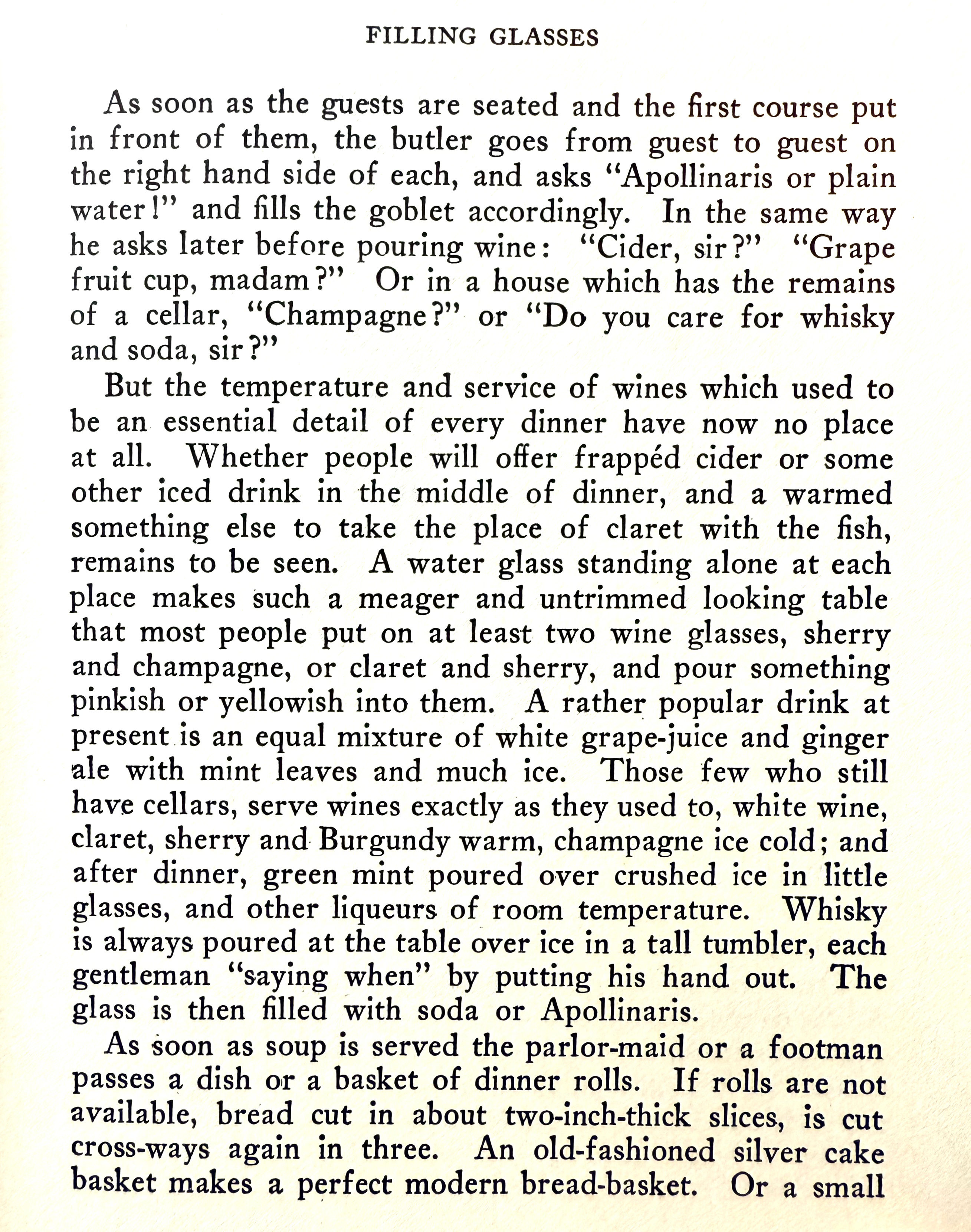
Etiquette, 1922, Filling Glasses and Presenting Dishes
Emily’s Formal Dinners chapter in her 1922 edition has loads of both classic and dated dining advice. In the following two sections, "Filling Glasses" and "Presenting Dishes," it’s fun to see what advice stands the test of time and what hasn’t. Emily also manages to squeeze in a little advice about serving bread at a formal dinner. Let’s take a look.
*Please note that the grammar, spelling, and attitude in the following excerpt follow 20th-century standards.
CHAPTER XIV
FORMAL DINNERS
Filling Glasses
Pg 205-206
FILLING GLASSES
As soon as the guests are seated and the first course put in front of them, the butler goes from guest to guest on the right hand side of each, and asks “Apollinaris or plain water!” and fills the goblet accordingly. In the same way he asks later before pouring wine: “Cider, sir?” “Grape fruit cup, madam?” Or in a house which has the remains of a cellar, “Champagne?” or “Do you care for whisky and soda, sir?”
But the temperature and service of wines which used to be an essential detail of every dinner have now no place at all. Whether people will offer frappéd cider or some other iced drink in the middle of dinner, and a warmed something else to take the place of claret with the fish, remains to be seen. A water glass standing alone at each place makes such a meager and untrimmed looking table that most people put on at least two wine glasses, sherry and champagne, or claret and sherry, and pour something pinkish or yellowish into them. A rather popular drink at present is an equal mixture of white grape juice and ginger ale with mint leaves and much ice. Those few who still have cellars, serve wines exactly as they used to, white wine, claret, sherry and Burgundy warm, champagne ice cold; and after dinner, green mint poured over crushed ice in little glasses, and other liqueurs of room temperature. Whisky is always poured at the table over ice in a tall tumbler, each gentleman “saying when” by putting his hand out. The glass is then filled with soda or Apollinaris.
As soon as soup is served the parlor-maid or a footman passes a dish or a basket of dinner rolls. If rolls are not available, bread cut in about two-inch-thick slices, is cut cross-ways again in three. An old-fashioned silver cake basket makes a perfect modern bread-basket. Or a small wicker basket that is shallow and inconspicuous will do. A guest helps himself with his fingers and lays the roll or bread on the tablecloth, always. No bread plates are ever on a table where there is no butter, and no butter is ever served at a dinner. Whenever there is no bread left at any one’s place at table, more should be passed. The glasses should also be kept filled.
CHAPTER XIV
FORMAL DINNERS
Presenting Dishes
Pg 206
PRESENTING DISHES
Dishes are presented held flat on the palm of the servant’s right hand; every hot one must have a napkin placed as a pad under it. An especially heavy meat platter can be steadied if necessary by holding the edge of the platter with the left hand, the fingers protected from being burned by a second folded napkin.
Each dish is supplied with whatever implements are needed for helping it; a serving spoon (somewhat larger than an ordinary tablespoon) is put on all dishes, and a fork of large size is added for fish, meat, salad and any vegetables or other dishes that are hard to help. String beans, braised celery, spinach en branche, etc., need a fork and spoon. Asparagus has various special lifters and tongs, but most people use the ordinary spoon and fork, putting the spoon underneath and the fork, prongs down, to hold the stalks on the spoon while being removed to the plate. Corn on the cob is taken with the fingers, but is never served at a dinner party. A galantine or mousse, as well as peas, mashed potatoes, rice, etc., are offered with a spoon only.
Grape juice, ginger ale, and mint with ice? Sign us up! We do get a kick out of the bread and butter service getting tucked into the Filling Glasses section, but that’s probably because we’re waist deep in editing the wedding book right now and all we can think about is where content belongs…and where it doesn’t. What’s extra interesting about this little section — aside from where it lives — is that it hails from an era where butter was not served at dinner, and dinner rolls thus could just be placed directly on the tablecloth.
However, this section on filling glasses makes a point of etiquette that dropped our jaws because we do not advise doing this today: putting a hand out to “say when” when being served beverages. While advised in this 1922 edition, today we find it’s more polite to look to your server and say “No thank you,” if you don’t care to have any, or “That’s plenty, thank you,” to let a server know when to stop pouring. While the purpose of just putting a hand out (whether that’s help up in a “stop” gesture, or over the glass as a “none for me” gesture) works, and does allow the guest or host to keep talking and stay focused on their dining companions, it’s best practice today to acknowledge the services performed for you. There are some supremely formal (and often official) engagements where it might be appropriate to give a hand signal to a staff member instead of a verbal one, but these are highly formal, protocol-driven events, meals, and meetings. And even in these cases, it would still be appropriate to say thank you to any servers after the meal or meeting, or when the conversation allows.
Presenting dishes is a wonderfully practical section, where Emily quickly details both how a server should present a dish and how a guest (or host) would help themselves to the items offered. Emily keeps her focus on the implements used for various dishes, but doesn’t mention whether to serve on the right or left of the guest. Today, we advise that servers stand to the guest’s left (as most people are right-handed, which allows the majority of guests to easily use their right hand to take the serving utensil and take an item or portion from the platter.
Please share your thoughts in the comments section below. Can’t post in the comments below? Sign up for a subscription today, or post on the Monday Podcast comment thread.
A Fabulous Gift
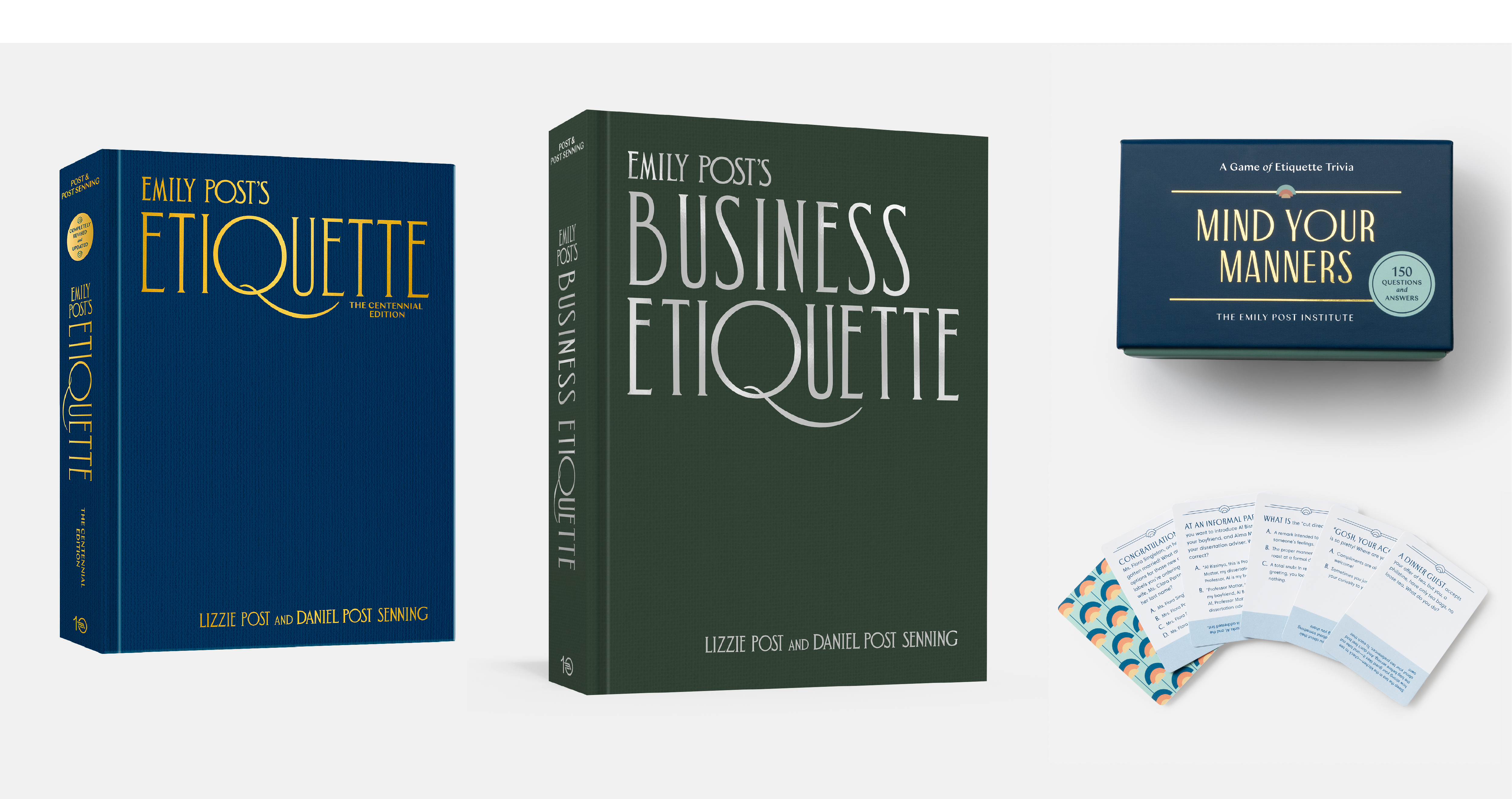
Signed copies of Emily Post’s Business Etiquette, Emily Post’s Etiquette - The Centennial Edition, and our Trivia Game: Mind Your Manners are all available and make for excellent gifts! Get your copies today from the fine folks at Bridgeside Books!
HELP KEEP EMILY POST PUBLISHING QUALITY CONTENT
If you enjoy Emily Post Etiquette and want to ensure we continue to create quality etiquette content and advice, please join our paid Community Membership. It is the most impactful way to contribute to the work we do at The Emily Post Institute. Your support makes a really big difference. Thank you!
Thank you for spending some of your day with us! If you haven’t checked out the podcast this week, here’s the link. Keep an eye on your inbox for the Saturday Sip; it’s coming up!
Until next time!
Lizzie and Dan
Missed our Community Member LIVES? We’ve got you covered!
Dan and Lizzie have been using Substack LIVE features to bring Community Members one Awesome Etiquette podcast question early and LIVE each week! If you’re not a Community Member sign up today! Can’t sign up right now? Check out the recorded versions on YouTube!